
The Airbus A320 air conditioning system is a complex but highly automated part of the aircraft’s Environmental Control System (ECS). Designed to ensure passenger comfort and crew satisfaction while maintaining proper pressurization and ventilation, the system intelligently blends bleed air, cooled air, and recirculated air across three cabin zones. This intricate system utilizes various components, including sensors, an air conditioning panel, and a distribution system to effectively manage cabin pressure and maintain optimal air quality.
Air is cooled through a series of processes that control the pack outlet temperature and ensure that the air supplied to the cabin meets the necessary standards for comfort and safety. In this post, we’ll break down the A320 air conditioning system basics, including pack operation, temperature control, and emergency ventilation.
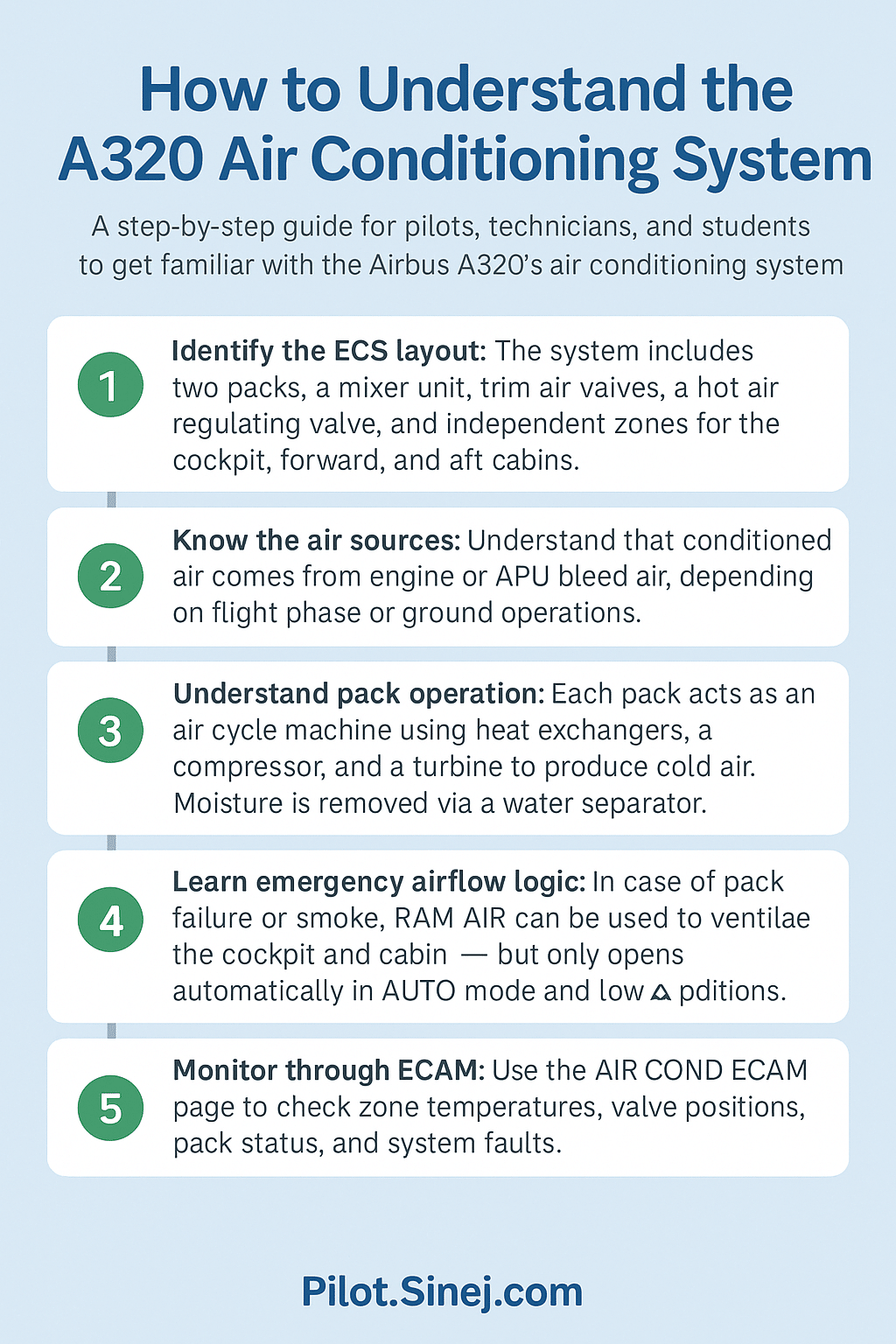
How to Understand the A320 Air Conditioning System
A step-by-step guide for pilots, technicians, and students to get familiar with the Airbus A320’s air conditioning system structure and logic.
- Identify the ECS layout: The system includes two packs, a mixer unit, trim air valves, a hot air regulating valve, and independent zones for the cockpit, forward, and aft cabins.
- Know the air sources: Understand that conditioned air comes from engine or APU bleed air, depending on flight phase or ground operations.
- Understand pack operation: Each pack acts as an air cycle machine using heat exchangers, a compressor, and a turbine to produce cold air. Moisture is removed via a water separator.
- Learn emergency airflow logic: In case of pack failure or smoke, RAM AIR can be used to ventilate the cockpit and cabin — but only opens automatically in AUTO mode and low Δp conditions.
- Monitor through ECAM: Use the AIR COND ECAM page to check zone temperatures, valve positions, pack status, and system faults.
How the A320 Air Conditioning System Is Structured
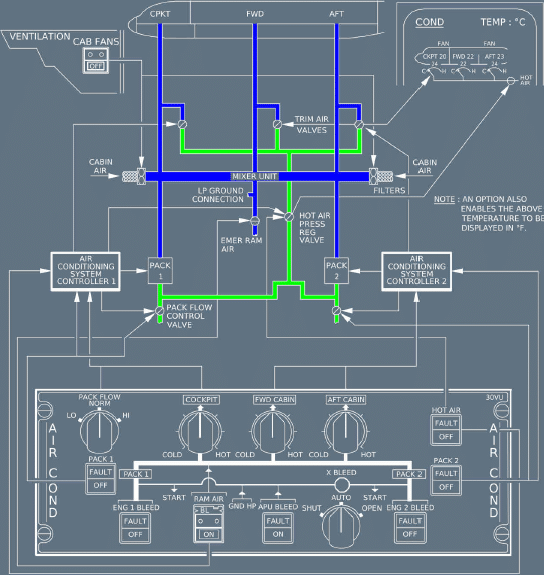
The system is designed around three independently controlled zones: the cockpit, forward cabin, and aft cabin. Conditioned air is supplied to these zones from two identical air conditioning packs, each powered by engine bleed air or the APU. Air passes through these packs, a central mixer unit, and is distributed to the various cabin zones.
Air Conditioning Packs: The Cooling Workhorses
Each pack functions as an air cycle machine. Hot bleed air passes through a primary heat exchanger, is compressed, cooled again through a main heat exchanger, and then expanded through a turbine. This expansion results in a significant temperature drop. A water separator removes moisture before the air is directed into the mixing unit.
Pack flow control valves, which are pneumatically operated and electrically controlled, modulate air flow into each pack. These valves close automatically during engine start, in the event of a pack overheat (on ground), or if the fire or ditching buttons are pressed.
Temperature Control and Zone Regulation
Temperature is controlled via the overhead AIR COND panel and fine-tuned by the Air Conditioning System Controllers (ACSCs). These controllers adjust trim air valves, which mix warm air (tapped upstream of the packs) with cold air from the packs. Each of the three zones has its own trim valve:
- Cockpit trim air – managed by ACSC 1
- Forward and aft cabin trim air – managed by ACSC 2
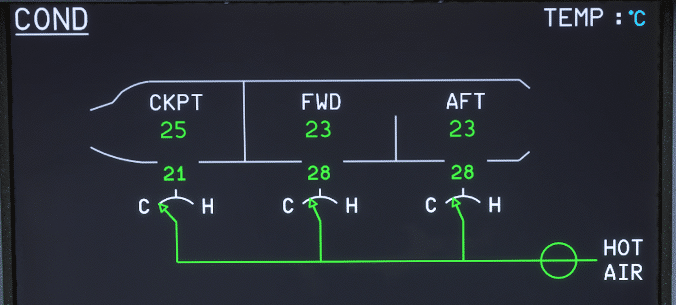
Cabin crew can manually adjust cabin temperatures within ±2.5°C using the FAP (Flight Attendant Panel).
The Role of the Mixer Unit
The mixer unit is where conditioned air from the packs blends with recirculated cabin air and, if applicable, low-pressure ground air or ram air. This helps reduce the amount of bleed air required and improves system efficiency. The mixed air is then distributed to the three cabin zones.
Emergency Ventilation: The RAM AIR System
If both packs fail or smoke evacuation is required, the RAM AIR pushbutton on the AIR COND panel can be activated. If differential pressure (Δp) is below 1 PSI and the system is in automatic mode, the outflow valve opens about 50%, allowing external airflow to ventilate the cabin and cockpit.
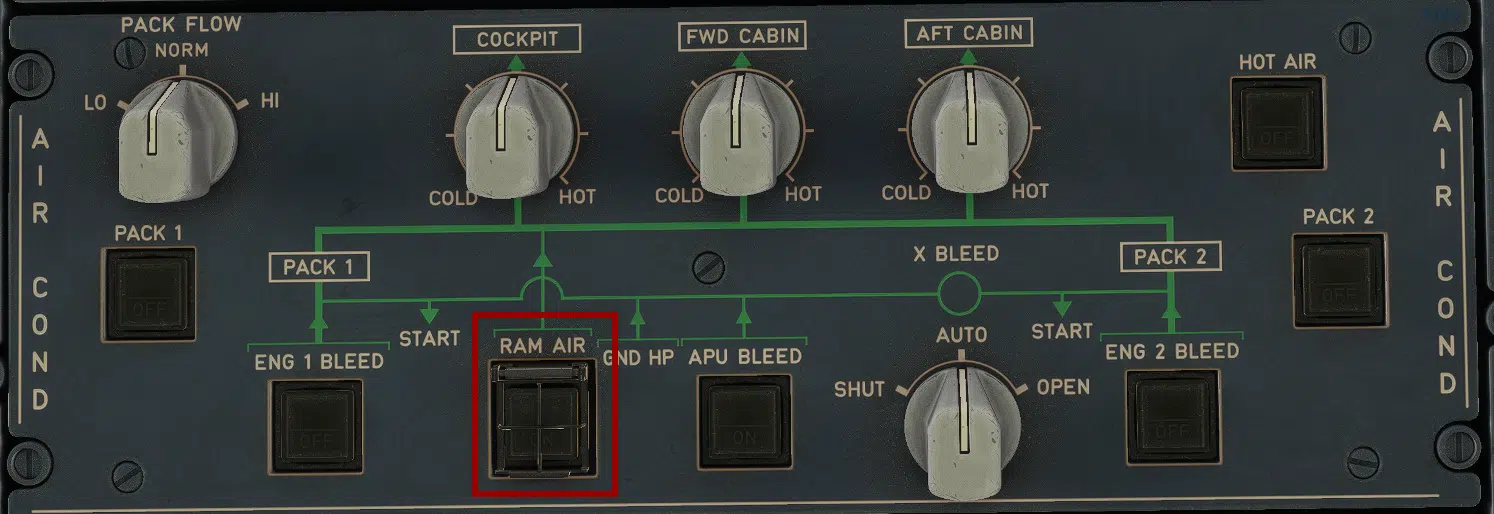
In manual mode, even if Δp is low, the outflow valve will not open automatically. Note that if the ditching pushbutton is pressed or Δp exceeds 1 PSI, the ram air inlet remains closed to prevent cabin depressurization.
Hot Air Pressure Regulation and Safety
The system taps hot air from upstream of the packs via a hot air pressure regulating valve, controlled by ACSC 1. This valve ensures appropriate warm air flow for trim mixing. It auto-closes under the following conditions:
- Both ACSC channels fail
- Duct overheat is detected
- Multiple trim air valves fail
System Redundancy and Automation
As with most Airbus systems, redundancy is a key design philosophy. Two packs ensure cooling performance, and two ACSCs manage all logic and failover. If a controller fails, its partner ACSC can take over critical functions. In degraded modes, pack operation or temperature control may be limited, but ventilation is always preserved.
Summary: Why It Matters
Understanding the A320 air conditioning system is more than memorizing temperatures and valves. It’s about knowing how to interpret ECAM messages, identify system failures, and take appropriate actions during abnormal operations. Whether you’re in the cockpit or studying for your type rating, knowing how the packs, mixers, and controllers interact gives you a deeper grasp of this essential comfort and safety system.
Frequently Asked Questions – A320 Air Conditioning System Basics
What are the main components of the A320 air conditioning system?
The system includes two air conditioning packs, a mixer unit, trim air valves, hot air regulating valve, temperature controllers (ACSCs), and a RAM AIR system for emergency ventilation.
How does temperature control work in the A320 cabin?
Temperature is managed by the ACSCs, which regulate trim air valves to mix warm air with cooled air from the packs. Each cabin zone—cockpit, forward, and aft—has individual control.
When does the RAM AIR system activate on the A320?
The RAM AIR system can be activated manually via the AIR COND panel, typically during smoke removal or dual pack failure. The outflow valve opens ~50% automatically if Δp is below 1 PSI and AUTO mode is active.
What causes the pack flow control valves to close automatically?
Pack valves close automatically during engine start, in case of a pack overheat (on the ground), or when the fire or ditching pushbuttons are activated.
What happens if one ACSC fails?
If one ACSC fails, the other controller can take over critical functions. The system is designed for redundancy, ensuring continuous ventilation and basic temperature regulation.